Diffuser vs Candle: Which Is Better for Your Home?
Posté par Appellation Editorial
If you're trying to decide how to scent your home – a candle or diffuser – they're not really competing. A candle wins for atmosphere. A diffuser wins for everyday use.
Candles instantly add ambience, filling a room with scent, warmth and the glow of a flickering flame – perfect for dinner parties, romance, or long, hot baths.
Diffusers offer calming, soothing, natural aromatherapy – allowing you to enjoy well-studied effects of essential oils on mood and stress, without a flame to watch. They switch off automatically, you can change the essential oil whenever you like, and they bring a mood of their own through gentle scent and the soft glow of LED light.
A candle can transform a bathroom into a relaxing sanctuary.
Key points
01 Many scented candles use synthetic fragrance oils; diffusers are designed for 100% natural essential oils.
02 A candle offers one fragrance at one intensity. A diffuser lets you adjust strength and change scent whenever you like.
03 An unattended flame is a risk, especially with children or pets. Diffusers switch off automatically.
04 Diffusers suit indoor, air-conditioned living – putting a little moisture back into the room.
How does each one scent a room?
With candles, the scent builds slowly from one fixed point, often taking an hour to fill a room. They rely on the warm air rising from the melt pool to carry the fragrance outwards.
An ultrasonic diffuser works differently. A small vibrating disc atomises water and essential oil into a fine, cool mist that lifts into the air, dispersing through a room in minutes.
Which gives you more control?
Strength. A candle has only one setting: lit or unlit. If the scent is too much for a small room, your options are to move it or blow it out. A diffuser allows you to adjust the output, or simply use fewer drops.
Timing. Most diffusers run on a timer or switch off when water in the reservoir runs out. A candle burns until you remember it, which is both a safety question and a waste question.
Switching scents. A candle commits you to one fragrance for 40 to 60 hours. With a diffuser, the variety is endless. You can use multiple essential oils and blends to suit your preference, mood, moment, or time of day.
Which is safer?
A candle has an open flame. The risk is not the flame itself but the moment you forget about it – when you fall asleep, or leave the house. There are other risks. A cat jumps onto the shelf. A curtain moves.
If a diffuser is knocked over, it will switch off automatically once the reservoir empties.
Children and pets. Diffusers stay cool to the touch, and if one is knocked over, the worst of it is spilled water. A candle in the same position could result in a house fire. As for the impact of fragrance on pets: a ventilated room rather than a closed one is always recommended – whether for air fresheners, candles or diffusers.
What about the air quality?
Anything you burn indoors releases more than scent. Candles release tiny particles and gases – soot, carbon monoxide and other compounds – that stay in the room with you.
1.52×
Peak PM10 concentration at the source, within 5 minutes of lighting a scented candle inside a home
The sensible conclusion? Use common sense: open your windows occasionally. Ventilate.
For those living indoors through cold Scandinavian winters, or hot Middle Eastern summers, ventilation is not always possible. Though even in the coldest European countries people still burp their homes – throwing the windows open for a few minutes to let stale air out and fresh air in. The practice comes from the German habit of lüften, or airing out, and takes about ten minutes.
Which works better in an air-conditioned home?
In smaller apartments, scent from candles or diffusers tends to be more noticeable. But in a larger villa, air conditioning has a dramatic effect on both.
Even with air-conditioning, diffusers can still disperse scent well, which is why placement is so important: somewhere open and central rather than tucked into a corner, next to a wall, and away from vents, open windows and fans, where strong air movement dilutes the aroma.
DIFFUSER Placement tip – away from walls, vents, fans and open windows. Our FAQ on where to put your diffuser goes into more detail.
Which costs less to run?
Candles are a significant investment – especially designer candles like Diptyque. The classic 190g Baies sells for around AED 331 (about USD 90) and gives you roughly 60 hours of burn time. That works out at about AED 5.50 (USD 1.50) an hour, and when it's gone, it's gone.
A diffuser is a one-off purchase that uses a few drops of oil per session, and lasts for years.
Can the scent of a candle or diffuser change how you feel?
Smell is the only sense that links directly to the limbic system, the oldest area of the brain, where emotions and memories are formed. It's why scent can shift your mood almost instantly, a field of study known as aromachology.
This connection between scent and mood is why you might unconsciously reach for a particular fragrance when you want to feel a certain way. For example, an uplifting citrus to brighten a morning, or a grounding woodsy or resinous scent to slow an evening down.
A diffuser allows you to choose a scent to suit your mood, the hour, the season.
Diffuser vs candle – how they compare
Candle
Diffuser
Scent control
One strength, one fragrance until finished
Adjustable output; change oils whenever you like
Timing
Burns until extinguished
Timer, with automatic shut-off
Safety
Open flame; needs attending
No flame; cool to the touch, auto shut-off
Ambience
Flickering flame is part of the appeal
Gentle scent and soft LED light; the object itself can be beautiful
Air
Adds combustion by-products
No combustion; still adds aromatic compounds
Cost
About AED 5.50/hour (designer); replaced when finished
One-off purchase, plus a few drops of oil per use
Warm climates
Wax can soften in heat; scent fights the air conditioning
Disperses well in air conditioning; store oils somewhere cool
Best for
Dinners, baths, occasions, the pleasure of a flame
Everyday use, bedrooms, desks, homes with children or pets
Oil burners: the middle ground between candles and diffusers
There is a third option that suits people who are drawn to diffusing but unwilling to give up candlelight.
An oil burner heats essential oil with a small tealight candle, with the flexibility of changing oils whenever you like. Ember, cast in brushed brass, works this way.
It's still an open flame, so the same attention applies as with any candle, but it's not a commitment to a single scent.
The verdict
A candle wins for
Atmosphere: dinner with friends, a leisurely bath, or an evening to yourself. There is a particular mood to candlelight that no device can replicate.
A diffuser wins for
Everything else. They cost less over time, offer endless variety in scent, and are equally at home on an office desk or a bedside table..



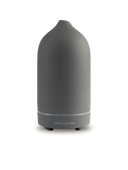


Diffuser vs Candle: Which Is Better for Your Home?
If you're trying to decide how to scent your home – a candle or diffuser – they're not really competing. A candle wins for atmosphere. A diffuser wins for everyday use.
Candles instantly add ambience, filling a room with scent, warmth and the glow of a flickering flame – perfect for dinner parties, romance, or long, hot baths.
Diffusers offer calming, soothing, natural aromatherapy – allowing you to enjoy well-studied effects of essential oils on mood and stress, without a flame to watch. They switch off automatically, you can change the essential oil whenever you like, and they bring a mood of their own through gentle scent and the soft glow of LED light.
Key points
01 Many scented candles use synthetic fragrance oils; diffusers are designed for 100% natural essential oils.
02 A candle offers one fragrance at one intensity. A diffuser lets you adjust strength and change scent whenever you like.
03 An unattended flame is a risk, especially with children or pets. Diffusers switch off automatically.
04 Diffusers suit indoor, air-conditioned living – putting a little moisture back into the room.
How does each one scent a room?
With candles, the scent builds slowly from one fixed point, often taking an hour to fill a room. They rely on the warm air rising from the melt pool to carry the fragrance outwards.
An ultrasonic diffuser works differently. A small vibrating disc atomises water and essential oil into a fine, cool mist that lifts into the air, dispersing through a room in minutes.
Which gives you more control?
Strength. A candle has only one setting: lit or unlit. If the scent is too much for a small room, your options are to move it or blow it out. A diffuser allows you to adjust the output, or simply use fewer drops.
Timing. Most diffusers run on a timer or switch off when water in the reservoir runs out. A candle burns until you remember it, which is both a safety question and a waste question.
Switching scents. A candle commits you to one fragrance for 40 to 60 hours. With a diffuser, the variety is endless. You can use multiple essential oils and blends to suit your preference, mood, moment, or time of day.
Which is safer?
A candle has an open flame. The risk is not the flame itself but the moment you forget about it – when you fall asleep, or leave the house. There are other risks. A cat jumps onto the shelf. A curtain moves.
If a diffuser is knocked over, it will switch off automatically once the reservoir empties.
Children and pets. Diffusers stay cool to the touch, and if one is knocked over, the worst of it is spilled water. A candle in the same position could result in a house fire. As for the impact of fragrance on pets: a ventilated room rather than a closed one is always recommended – whether for air fresheners, candles or diffusers.
What about the air quality?
Anything you burn indoors releases more than scent. Candles release tiny particles and gases – soot, carbon monoxide and other compounds – that stay in the room with you.
1.52×
Peak PM10 concentration at the source, within 5 minutes of lighting a scented candle inside a home
Scientific Reports, 2025
A 2025 study in Scientific Reports measured particulate matter in real homes after lighting a scented candle, and found PM10 concentrations peaked at 1.52 times the baseline at the source within five minutes, with finer PM2.5 and PM1 staying elevated three and six metres away.
Researchers at EPFL conclude that candles degrade indoor air quality. A diffuser involves no combustion, avoiding soot and carbon monoxide.
That said, no scent is entirely inert. In 2025, researchers at Purdue University tested flameless scented wax melts and found that aroma compounds reacted with ozone in indoor air to form nanoparticles, published in Environmental Science & Technology Letters. Unscented wax produced none. Other research (funded in collaboration with candle manufacturers) concluded that scented candles do not pose known health risks under normal use.
The sensible conclusion? Use common sense: open your windows occasionally. Ventilate.
For those living indoors through cold Scandinavian winters, or hot Middle Eastern summers, ventilation is not always possible. Though even in the coldest European countries people still burp their homes – throwing the windows open for a few minutes to let stale air out and fresh air in. The practice comes from the German habit of lüften, or airing out, and takes about ten minutes.
Which works better in an air-conditioned home?
In smaller apartments, scent from candles or diffusers tends to be more noticeable. But in a larger villa, air conditioning has a dramatic effect on both.
Even with air-conditioning, diffusers can still disperse scent well, which is why placement is so important: somewhere open and central rather than tucked into a corner, next to a wall, and away from vents, open windows and fans, where strong air movement dilutes the aroma.
Which costs less to run?
Candles are a significant investment – especially designer candles like Diptyque. The classic 190g Baies sells for around AED 331 (about USD 90) and gives you roughly 60 hours of burn time. That works out at about AED 5.50 (USD 1.50) an hour, and when it's gone, it's gone.
A diffuser is a one-off purchase that uses a few drops of oil per session, and lasts for years.
Can the scent of a candle or diffuser change how you feel?
Smell is the only sense that links directly to the limbic system, the oldest area of the brain, where emotions and memories are formed. It's why scent can shift your mood almost instantly, a field of study known as aromachology.
This connection between scent and mood is why you might unconsciously reach for a particular fragrance when you want to feel a certain way. For example, an uplifting citrus to brighten a morning, or a grounding woodsy or resinous scent to slow an evening down.
Diffuser vs candle – how they compare
Oil burners: the middle ground between candles and diffusers
There is a third option that suits people who are drawn to diffusing but unwilling to give up candlelight.
An oil burner heats essential oil with a small tealight candle, with the flexibility of changing oils whenever you like. Ember, cast in brushed brass, works this way.
It's still an open flame, so the same attention applies as with any candle, but it's not a commitment to a single scent.
The verdict
A candle wins for
Atmosphere: dinner with friends, a leisurely bath, or an evening to yourself. There is a particular mood to candlelight that no device can replicate.
A diffuser wins for
Everything else. They cost less over time, offer endless variety in scent, and are equally at home on an office desk or a bedside table..
Shop stone diffusers Shop brass burners